Rules
Part of Musician net worth: the complete list, checked
Framing musician net worth methodology: the band, worked through
Musician net worth methodology taken apart: the ledger of public events behind every figure, and the two private facts that decide the whole answer.
Take a band of four people. Same albums, same tours, same chart history, same photographs on the same lists. Give a standard estimating method their public record and it will produce four similar figures.
Give their accountants the same question and the four answers could sit in different orders of magnitude. One member wrote the songs, one owns a share of the recordings, one was paid a wage by the other three, and one left before the catalog was sold.
That thought experiment is the whole problem with musician estimates. The method works from events everyone can see. The money is decided by shares nobody can.
What to take away
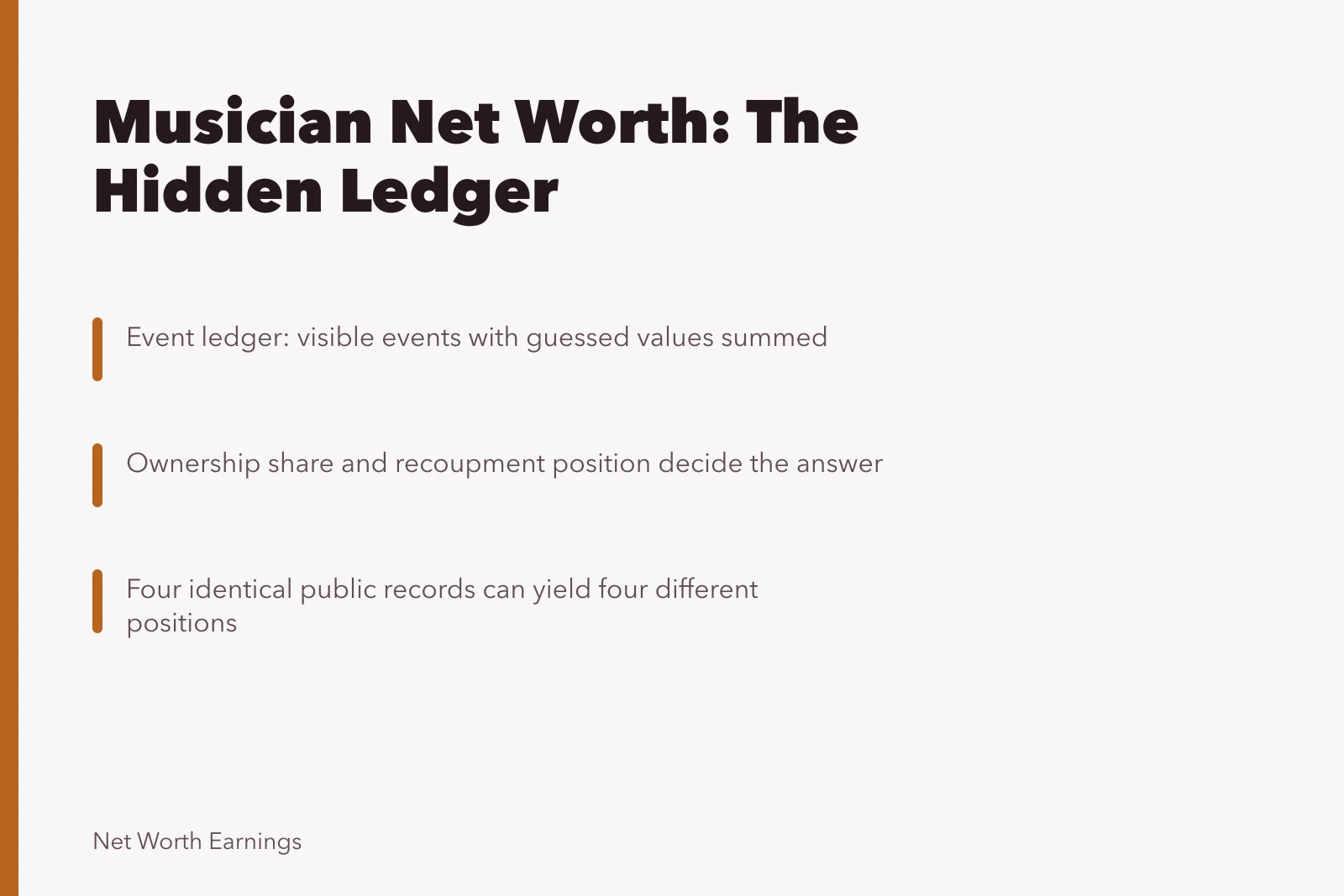
- The standard method is an event ledgervisible events, each assigned a guessed value, summed.
- Ownership share and recoupment position decide the answer, and neither is visible.
- Four people with an identical public record can have four entirely different financial positions.
How the figure is actually built
Strip the process to its bones and it is a ledger of public events with an invented value beside each.
Public Event vs Private Document
Visible event
- Album release
- Sales, streams
- Songwriting credit
- Assumed share
- Tour dates
- Reported gross
- Catalog sale
- Announced price
- Sync placements
- Guessed fee
- Property
- Purchase price
- Brand deals
- Guessed value
Estimator assumes
- Album release
- Recording contract
- Songwriting credit
- Split agreement
- Tour dates
- Promoter deal
- Catalog sale
- Which rights sold
- Sync placements
- Negotiated per use
- Property
- Ownership structure
- Brand deals
- The contract
What decides it
- Album release
- Songwriting credit
- Tour dates
- Catalog sale
- Sync placements
- Property
- Brand deals
What the estimator assumes
- Album release and chart position
- Sales and streams converted at an assumed rate, an assumed artist share
- Songwriting credit
- An assumed share of the composition's earnings
- Tour dates
- Reported gross, an assumed share to the artist
- Catalog sale
- The announced price, credited to the artist
- Sync placements
- A guessed fee per placement
- Property
- Purchase price
- Brand deals
- A guessed value per deal
What actually decides it
- Album release and chart position
- The recording contract, recoupment balance, whether the artist owns any of the recording
- Songwriting credit
- The split agreement with co-writers, the publishing deal, whether publishing was sold
- Tour dates
- The promoter deal, production cost, the size of the touring party, how the band divides its share
- Catalog sale
- Which rights were sold, who else held shares, prior assignments, staged payments
- Sync placements
- Negotiated per use, split between publisher and label sides, shared with co-writers
- Property
- Financing and ownership structure
- Brand deals
- The contract, of which nothing is public
Every row has the same shape. A real, checkable event on the left. A private document on the right. A guess in the middle doing the work.
The two unknowns that swamp everything
Most of the assumptions in the table are wrong by some margin. Two of them are wrong by enough to change the answer completely.
Two Unknowns That Swamp Everything
Does the artist own recordings or publishing?
Royalty stream for life of copyright
Single fee, already spent
Ownership share. Whether the person owns their recordings, owns their publishing, holds a share of each, or holds neither, is the difference between a stream of royalties and a single fee already spent. It changes what a hit means. The public record shows credits, which are facts about authorship, not ownership. The Copyright Office's records of registrations and recorded documents show who claimed what, and transfers that were recorded, and even that is a partial view because assignments need not be recorded there to be valid.
Recoupment position. An advance is repaid from royalties before any further royalties are paid. An artist who has released successful records can be years from receiving a further royalty payment because the balance has not cleared, and cross-collateralisation can pull one project's earnings into another's debt. The estimator sees the releases. The balance is a private ledger entry that never appears anywhere.
Get either of these wrong and no amount of accuracy elsewhere rescues the figure. Get both wrong and the output is unrelated to the person.
The band, worked through
Return to the four members. The public record is identical for all of them. Here is how the private facts diverge.
- The member who wrote the songs holds composition income from every use of every song, for the life of the copyright, wherever the songs are played. If the publishing was later sold, that stream became a one-off payment, on private terms.
- The member who negotiated a share of the recordings holds recording income after recoupment, and a share of any catalog sale, on whatever split the band agreed years ago.
- The member who was paid a wage by the others has a documented fee history and no rights. That income stopped when the work stopped.
- The member who left before the sale may hold a share in the recordings they played on, or may have been bought out, on terms that have never been described anywhere.
Any estimate treating these four alike is not approximately right about all of them. It is unrelated to all of them, and it has no way of knowing which one it is closest to.
Where the method could be honest
A defensible musician-specific method would state, for each entry, which copyrights the person holds, on what evidence, and what is known about recoupment. For nearly everyone, both answers are nothing.
The Copyright Office's overview of what copyright protects shows how much value in this trade sits in rights, not payments. That part cannot be observed.
The honest outputs are the same three as everywhere else. A documented slice: a registration record, a court finding, a company's filed accounts. A range wide enough to include "owns everything" and "owns nothing". Or a refusal, and an explanation.
The general pipeline of assumptions and where each one bends is on estimate methodology. Announced grosses and sale prices become the raw material for figures on musician net worth.
Outputs then get sorted into a list on richest rankings. The anatomy of the recording deal that sets the artist's share is closest to the term deals described on contracts and salaries.
Common questions
Do streaming counts help, since they are public?
They are a public measure of use. Converting use to income requires the artist's share on both copyrights, the recoupment position and every intermediary's cut. The count is the one input that is known, and it is the least important.
Is a catalog sale the moment the answer becomes knowable?
It is the moment a price becomes public. What was sold, who else was paid, how the consideration was staged and what was retained stay private. It is a better-documented event than most and still not a balance.
What should a reader do with a musician estimate?
Ask what the article believes the person owns. If it does not say, the figure was built without the input that matters.