Features
Part of Reading richest rankings with a sceptical eye
Good highest richest rankings choices usually start with why we publish no ranking
Highest richest rankings claims for 2027 examined at the root: what a superlative asserts, why it needs complete coverage, and why nobody can have it.
Set aside the individual figures for a moment. A page titled with a superlative is making a claim before it prints a single number, and that claim is stronger than any of the estimates that follow. Saying somebody is the highest of anything asserts something about everyone who is not on the page.
What to take away
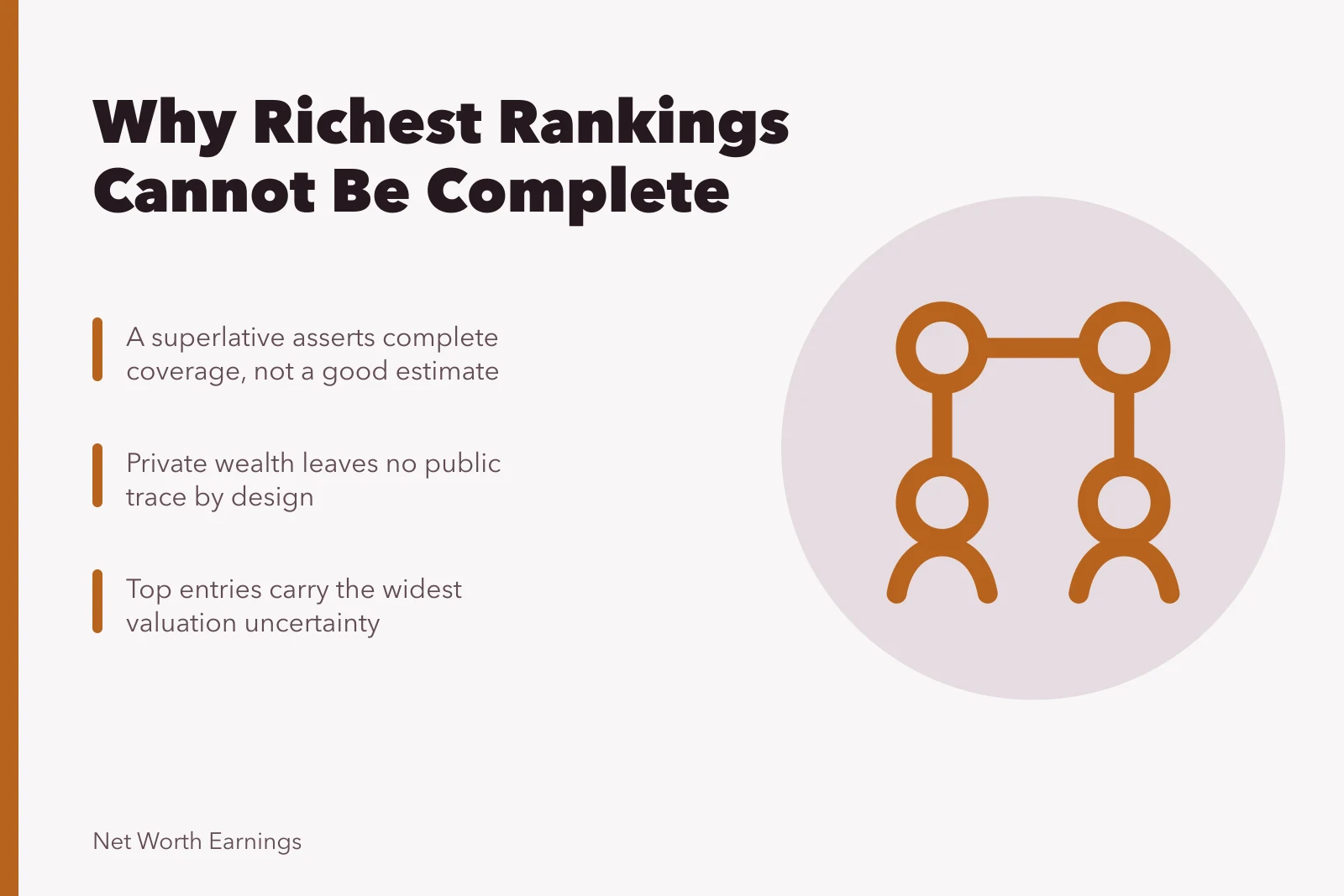
- A superlative asserts complete coverage of a population, not a good estimate.
- Coverage of private wealth is impossible in principle, not merely difficult.
- The claim fails even if every listed figure happened to be right.
What a superlative requires
To say that a person is the wealthiest of a group, three things must hold.
What a Superlative Requires
- Group is definedwho, criteria, as of when
- Every member has been valued, not just visible ones
- Valuations separated by more than their uncertainty
- Condition one is a choice compilers can make
- Conditions two and three are facts, and both fail
Condition one is a choice a compiler can make and usually does not state. Conditions two and three are not choices. They are facts about the world, and both fail.
Why complete coverage is impossible here
Wealth held privately leaves no public trace by design. Someone whose assets sit in private companies, in jurisdictions that publish little, or in structures held through other structures, produces no signal a compiler could find. There is no register of wealthy people anywhere to check a list against.
This is different from the usual complaint about accuracy. An inaccurate estimate could in principle be improved. A missing person cannot be estimated at all, because nobody knows to look. A ranking can only order the people it found, which makes every rich list a ranking of visibility with a superlative attached.
The general problem of what the record does and does not contain is on estimate methodology.
Why the top of the list is the least stable part
Counterintuitively, the superlative applies to the part of the table with the widest uncertainty. Entries near the top are dominated by holdings in private companies, in stakes that must be priced by comparison, and in assets that move with markets. Small changes in a chosen multiple or a valuation date move those entries substantially.
So the strongest claim on the page sits over the shakiest arithmetic. A first position that survives a change of valuation date by one week is not a finding, and readers are given no way to test it.
What could be said honestly
| Honest claim | What it needs |
|---|---|
| This person's disclosed holdings in this company, at this date, were reported as this | One filing, retrievable through the SEC's EDGAR full text search |
| This transaction was announced at this price on this date | The announcement, and a note that it says nothing about who received what |
| Household wealth in this country is distributed like this | A survey with a published design, such as the Federal Reserve's distributional financial accounts |
| This dispute established these facts | Court filings, described in the judiciary's guide to court records |
Every row is narrow, dated and checkable. Not one of them contains a superlative, and that is not an accident. Superlatives require completeness, and completeness is the thing nobody has.
Why we publish no ranking
The title would be a claim we could not support, even before the figures. A page saying anyone is highest at anything financial needs knowledge of everyone else, and no compiler on earth has it.
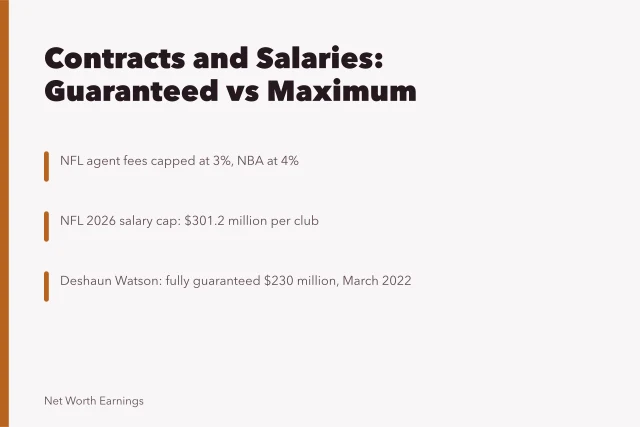
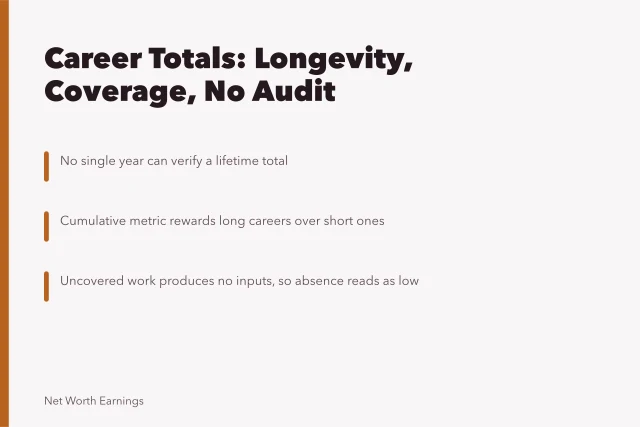
The format-level argument is on richest rankings. The same superlative fails inside one industry on contracts and salaries, and the lifetime version is on career earnings.
Common questions
Could a superlative work for a narrow, fully disclosed group?
Closer to workable. For a defined set of officers at companies with disclosure obligations, you could say who reported the largest disclosed pay in a year. That is a statement about filings rather than about wealth, and it would have to be titled that way.
Does anyone verify these superlatives after publication?
There is nothing to verify against. That is precisely why the claim survives: it cannot be tested, so it is never falsified, and never being falsified reads as being confirmed.
Why does the same name stay at the top for years?
Because the entries are inherited and the population is stable. Persistence at the top is a property of the method rather than evidence about anybody.