Costs
Guide to creator net worth: what is genuinely checkable
Creator net worth and why the multiply-by-views method collapses: the missing cost side, and the four layers between a channel and its owner.
Search what an online creator earns and you get a calculator: paste a channel name, and it returns a figure. The tool takes a public view count and then multiplies it by an advertising rate the tool made up. That simple method is the entire approach.
Understanding why it fails is the fastest route into how creator income actually works.
What to take away
- View counts do not convert to income at any fixed rate, and the things that set the rate are invisible from outside.
- A creator operation is a business with a cost side, and the cost side is never modeled.
- Revenue, company profit, the owner's income and the owner's wealth are four different numbers.
Why the multiply-by-views method collapses
The calculator needs a rate per thousand views. That rate is not a constant, and the things that move it cannot be seen from outside.
Why view-count estimates fail
- Advertiser rate minus platform share
- Audience geography changes monetisation
- Category limits or excludes ads
- Ad blocking and subscriptions
- Seasonal ad demand swings
Advertiser rates are not creator rates. What an advertiser pays and what a creator receives differ by the platform's share, and the gap is a matter of contract, not of arithmetic.
Audience geography dominates. The same view count monetises very differently depending on which advertising markets the audience sits in. Two channels with identical numbers can be in different businesses.
Category changes everything. Advertisers bid differently against different subject matter. Some categories are limited or excluded from monetization altogether, and the view count gives no hint of which.
Not every view carries an ad. Ad blocking, subscription tiers, viewer age settings, video length, and the platform's own decisions about what is advertiser-friendly all break the link between views and impressions.
Seasonality is large. Advertising demand swings across the year. An annual figure extrapolated from one month can be wrong in either direction by a lot.
Stack five unknown multipliers and the output is not an estimate. It is a number with a plausible shape.
The half nobody models: costs
Even a correct revenue figure would not be income. A working creator operation has an expense side, and it is often the bigger story.
The half nobody models
- Editors, camera operators, writers, producers, moderators and managers, whether staff or freelance.
- Equipment, software, studio space, insurance.
- Travel and production costs for anything filmed away from a desk.
- Payments to a network or management company where one is involved.
- Refunds, chargebacks and clawbacks on merchandise and memberships.
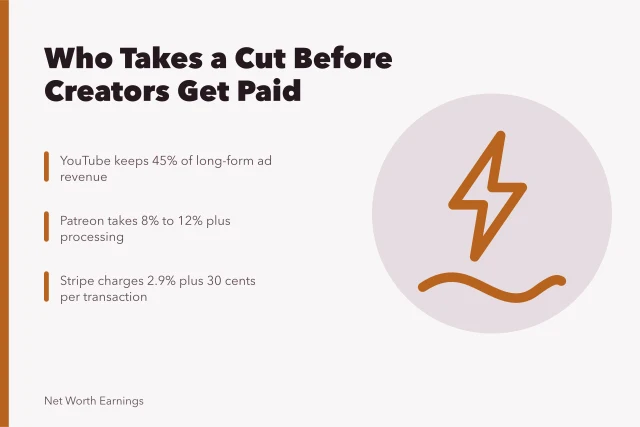
- Platform fees on every revenue line, at different rates per line.
- Tax, which for a business runs on rules quite different from a salary, and which form the business takes changes all of it, as the IRS sets out in its overview of business structures.
A channel with impressive gross revenue and a large production payroll can leave its owner with far less than a smaller operation run alone. Nothing in the public metrics distinguishes them.
Revenue, the business, and the person
This is the distinction that most creator figures skip.
Four layers, none visible
Layer
- Platform revenue
- Ad share, memberships, tips
- Other revenue
- Sponsorship, merch, licensing
- Company profit
- All revenue minus all costs
- Owner's income
- What leaves the company
- Owner's net worth
- Accumulated after tax and debt
Visible from outside?
- Platform revenue
- No, unless disclosed
- Other revenue
- No
- Company profit
- No
- Owner's income
- No
- Owner's net worth
- No
| Layer | What it is | Visible from outside? |
|---|---|---|
| Platform revenue | Advertising share, memberships, tips, subscriptions | No, though creators sometimes disclose it voluntarily |
| Other revenue | Sponsorship, affiliate, merchandise, licensing, live events, courses | No |
| Company profit | All revenue minus all costs | No |
| Owner's income | What actually leaves the company for the person | No |
| Owner's net worth | Accumulated after tax, spending and debt | No |
Every layer has its own answer, and articles routinely quote a figure from the top row while using the language of the bottom one. A creator business is a company. Treating its revenue as its owner's wealth would be an obvious error if the same sentence were written about any other kind of firm.
Where the sponsorship numbers come from
Commercial relationships do have to be disclosed to the audience, as the Federal Trade Commission's guidance for social media influencers sets out. A disclosure marks that a deal exists without revealing what it paid.
Brand deal figures in circulation almost never come from documents. They come from rate cards, marketplace averages, other creators describing offers, and the person's own public statements, each with a purpose, usually negotiation.
A rate card is an opening ask. A reported deal value may bundle deliverables spread over a year, performance components that may not be reached, and product rather than cash.
What is genuinely checkable
Not much, which is the honest answer, but not nothing.
Some creators publish their own revenue breakdowns, and those are worth reading as first-party statements with a known motive rather than audited accounts.
Where a creator business is a registered company, some jurisdictions require accounts to be filed. Those filings describe the company, not the person. If a listed company acquires or merges with a creator company, the deal may surface in its filings, and litigation occasionally exposes contract terms.
Everything else is inference. The same problem in a field with far better documentation is set out on athlete net worth. The two older performing trades, where pay runs through unions and rights rather than platforms, are covered on actor net worth and musician net worth.
Common questions
Creators post their own income reports. Aren't those reliable?
They are first-party statements, which is better than a calculator and not the same as verified. Note what is included and what is not: gross or net, business or personal, one platform or all of them. Reports differ on all three.
Do subscriber counts predict earnings?
Weakly at best. Audience size, audience location, subject category and business model each matter more, and a small audience in a high-value category can out-earn a much larger general one.
Why do estimates for the same creator vary so widely?
Because the tools that produce them differ mainly in the invented rate they use. Change the assumed rate and the output changes proportionally, which is why the numbers scatter without any of them being better informed.
In this guide
- What a creator net worth estimate assumesFollower counts, view counts, payout terms and store prices each measure attention, not money, so a creator net worth estimate rests on assumptions.
- Comparing who takes a share before the creator and the part nobody sees for creator net worth earningsPlatforms, agencies, networks and processors all take a cut before a creator is paid, and the hidden costs decide what actually reaches them.
- Sorting out creator net worth methodology: the chain, link by linkCreator net worth methodology traced through its conversion chain: six multiplications between a public view count and a person, each one a guess.
- Highest creator net worth in one sourced placeHighest creator net worth figures for 2027, with each name tied to a dated source: SEC filings, court records, trademark registrations and disclosed deal terms.
- A closer look at creator net worth mistakes, 2027 editionCreator net worth mistakes start with views treated as revenue and rate cards treated as fees, and compilers repeat both errors in every estimate.