Industry
A closer look at creator net worth mistakes, 2027 edition
Creator net worth mistakes start with views treated as revenue and rate cards treated as fees, and compilers repeat both errors in every estimate.
A view is an event on a platform. Revenue is a separate thing that may or may not follow it. Most creator net worth mistakes begin when a writer treats the first as proof of the second.
What to take away
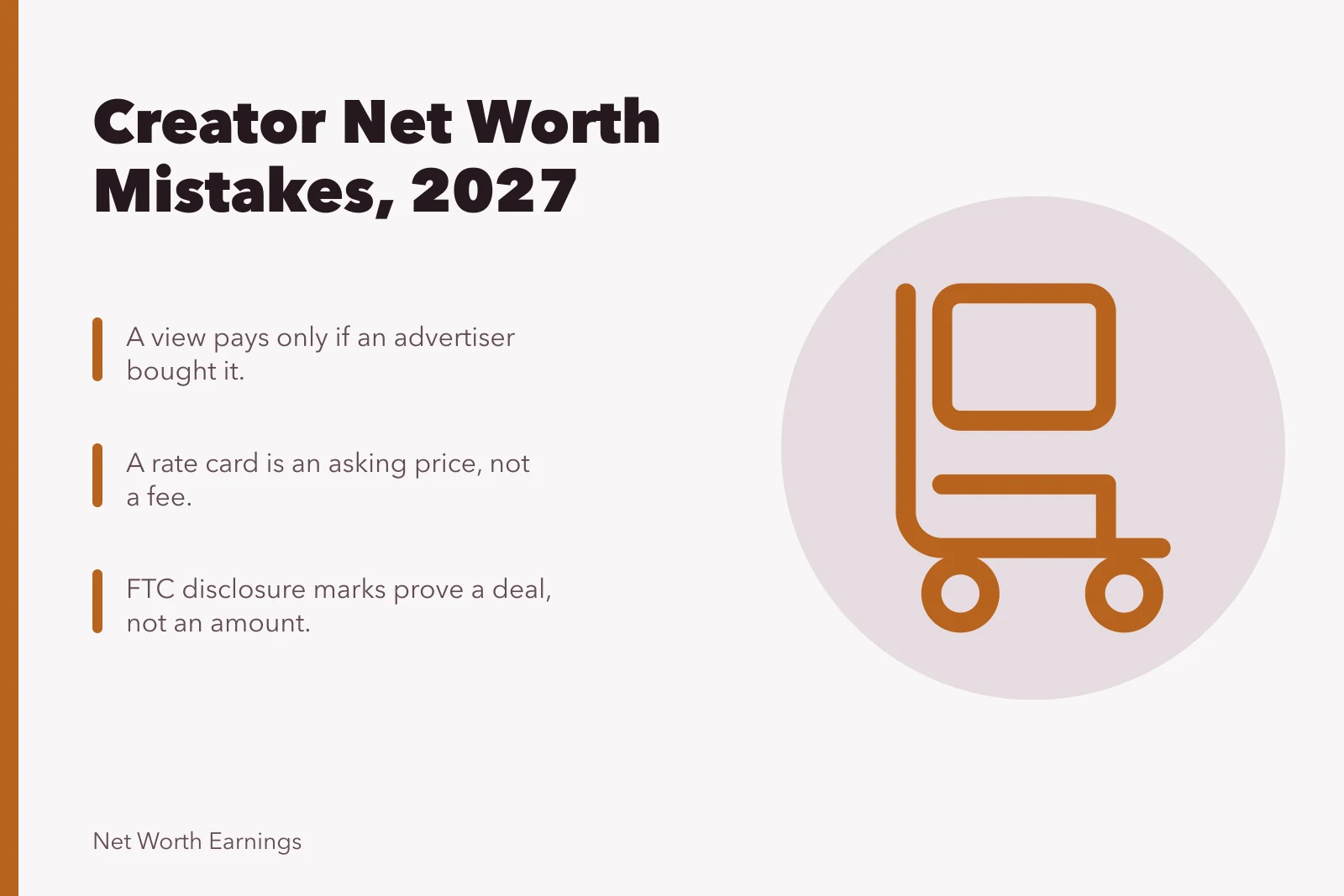
- A view pays only when an advertiser bought against it, in that country, in that category, that month.
- A published rate card is an asking price, not a fee anyone paid.
- An FTC disclosure mark proves a commercial relationship existed and states no amount.
- A business's revenue is not its owner's income; staff, platform share and tax come out first.
- No verifiable net worth figure exists for most creators, and a page that supplies one anyway is guessing.
Views are not revenue
Platform payouts depend on whether an advertiser bought inventory against the view, in which country it was served, in which category, and in which quarter. A comedy clip and a finance clip can draw identical view counts and earn figures that differ by an order of magnitude.
Same Views, Different Payouts
Comedy clip
- View count
- identical
- Advertiser bought
- maybe
- Country served
- varies
- Category
- comedy
- Quarter
- varies
- Earnings
- order of magnitude apart
Finance clip
- View count
- identical
- Advertiser bought
- maybe
- Country served
- varies
- Category
- finance
- Quarter
- varies
- Earnings
- order of magnitude apart
Writers who skip that step assume a rate and never show it. The result looks precise and rests on nothing.
Rate cards are asking prices
A published rate is where a negotiation opens. Deals close below it, get bundled with other creators, get paid partly in product, or never close at all. Nobody outside the room sees the signed number.
Treating a rate card as a fee is the second most common error in this genre, and the easiest to catch: if the article cites a rate but no contract, it has priced a wish.
Disclosure marks are not invoices
The Federal Trade Commission requires creators to disclose paid relationships, and its disclosures guidance for social media influencers sets out what that looks like. A hashtag satisfies the rule. It does not say whether the deal paid cash, paid in product, or paid a flat fee plus a performance bonus.
Compilers count the marks and attach a price. That price is invented, even when the count is accurate.
Whose money is it
A channel run through a company with several owners is not one person's asset. The entity type decides who owns what and who carries liability, and the IRS explains the differences in its overview of business structures. None of that is visible from the videos.
Two failures follow. A compiler attributes company activity to an individual. Or the compiler finds both the person and the company, and counts the same money twice.
Costs are the missing half
Most published creator estimates carry no cost line at all. For a solo operator that is a modest distortion. For a channel with editors, a studio and a product line, the omitted costs are most of the answer.
Revenue for the business gets labeled income for the person. The two are not close.
Platform terms are not personal terms
A platform publishes the rules of its revenue program. Applying those rules to an account assumes the account was enrolled, assumes when it joined, and assumes no separate network agreement overrode the standard split. Each assumption is checkable and rarely checked.
The symptom table
| Symptom in the article | What it tells you |
|---|---|
| A figure with no period attached | The writer does not separate a year from a career |
| Views cited as the basis | A rate was assumed and not shown |
| A count of brand deals | A fee was assumed and not shown |
| No mention of a team or costs | The estimate is revenue, labeled as wealth |
| A round number | The output of round assumptions |
| Sources that are other articles | The figure was inherited, not derived |
Run the table against the next creator article you read. It takes under a minute and usually returns three or four symptoms on one page.
Symptom Check
- Figure with no period attached
- Views cited as the basis
- A count of brand deals
- No mention of a team or costs
- A round number
- Sources that are other articles
The error underneath
Every mistake above is one mistake: treating a measure of attention as a measure of money. Attention is what this trade publishes. Money is what the article claims to describe.
The gap between them holds the platform's share, the agency's cut, production cost, tax, and every later decision the person made. That gap is where the answer lives. The step-by-step argument is on estimate methodology.
Why it keeps happening
The honest output does not travel. A page saying the defensible range is very wide gets no clicks; a page with a number gets clicks. That incentive is stable, which is why the genre keeps producing the same errors.
How the pressure shapes ranked lists is on richest rankings. The structure the errors leave out is on creator net worth, and the deals at the center of most of them are on endorsement income.
Common questions
Is a creator's own figure more reliable?
Usually, with a caveat. Self-reported numbers often mix business revenue with personal income, or quote a strong month as a standing rate. They still beat an outside guess, because the person had access to the accounts.
Which mistake causes the largest error?
Omitting costs. For a solo creator it shifts the answer moderately. For a team operation it can turn a business losing money at scale into a headline about wealth.
Does better platform data fix this?
It improves the measured input, which was never the weak link. The private parts stay private, and the estimate has to be built around that.
Why do round numbers keep appearing?
Round inputs produce round outputs. A writer who assumes a rate, a deal count and a cost ratio in round figures will publish a round figure, and it will read as though someone calculated it.