Rules
NIL Money Rules in Texas and California: What College Athletes Earn in 2027
Texas and California NIL money rules compared: SB 1385, SB 206, collectives, revenue sharing, state tax and what college athletes keep by 2027.
What to take away
- Texas SB 1385 and California SB 206 both let college athletes earn from endorsements, and both bar the school itself from paying them under the 2021 statutes as written.
- The earnings gap is mostly taxTexas has no state income tax, and California's top marginal rate reaches 13.3 percent, plus a 1 percent mental health services surcharge above $1 million.
- Collectives and direct revenue sharing, capped at $20.5 million per school per year after the 2025 House settlement, now move more money than the state statutes do.
- Texas requires athletes to disclose NIL contracts to their school, and California's SB 206 leaves that to campus policy rather than state law.
- By 2027, state law matters less for access and more for take-home pay, disclosure paperwork and compliance review.
Two state statutes, two rule sets
Texas SB 1385 was signed in June 2021 and took effect July 1, 2021, the same day the NCAA opened NIL earning nationwide. The statute allows endorsement deals, bans pay-for-play, and keeps schools from arranging deals for athletes.
California moved earlier. SB 206, the Fair Pay to Play Act, was signed in September 2019. It lets athletes earn from their name, image and likeness, blocks the NCAA from punishing them, and forbids scholarship cancellation as a penalty for getting paid.
A name, image and likeness deal is a commercial contract built on a player's public identity. It is not a salary, and that distinction sits at the center of both statutes.
Where Texas and California diverge
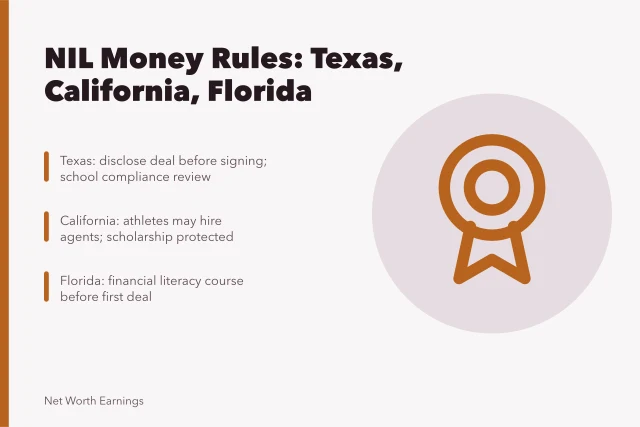
Texas writes more bans into the text. Deals involving alcohol, tobacco, gambling and firearms sit outside the law's protection. The athlete must disclose contract terms to the institution.
California gives campuses room to set their own limits. SB 206 does not list banned product categories, and it does not place a state disclosure duty on the athlete.
Both states still defer to NCAA rules on eligibility. A contract that breaks NCAA rules can cost an athlete eligibility even when state law allows the deal.
How the money actually reaches an athlete
- A brand, a local business or a collective signs the athlete. A collective is a booster-funded group that pools money for a roster.
- The school's compliance office reviews the contract against state law and NCAA rules.
- Payment arrives from the collective or the brand, and the athlete reports it as income on a tax return.
Since 2025, schools in the power conferences can also share revenue directly with athletes. The House v. NCAA settlement set a cap near $20.5 million per school per year and about $2.8 billion in back pay.
A state law can permit a deal. It cannot guarantee a buyer.
Revenue sharing is separate from NIL. An athlete can hold a revenue share payment and an endorsement deal at the same time, and both are taxed the same way.
What taxes take from the same check
Federal tax applies in both states. IRS Publication 525 covers taxable income including bonuses and prizes, and NIL payments fall in that bucket.
| Taxable NIL income, single filer | Texas state tax | California top marginal rate |
|---|---|---|
| $50,000 | 0 percent | 6 percent |
| $250,000 | 0 percent | 9.3 percent |
| $1,500,000 | 0 percent | 13.3 percent plus 1 percent surcharge |
California brackets adjust each year. Texas collects no state income tax at all.
Royalty income from a licensed likeness follows the same route as residual payments to performers, which the IRS counts as taxable.
Example: one check, two state bills
A collective in Austin and a collective in Los Angeles can sign identical $250,000 contracts. The Texas athlete owes no state income tax on that payment. The California athlete pays state tax across several brackets, with the top slice at 9.3 percent, so the state bill runs into five figures.
The same split shows up at small amounts. A $5,000 autograph payment is light in Texas and still reportable in California.
What changes by 2027
Three forces will shape 2027 earnings. Revenue sharing is expanding, state legislatures keep rewriting statutes, and Congress keeps weighing a federal NIL standard that would flatten some state differences.
For an athlete picking a school, the math is now deal access, collective strength, state tax rate and disclosure workload. The statute sets the floor. The tax code sets the net.
Our breakdown of NIL money by state rules covers how Texas, California and Florida treat deals, NCAA limits and disclosure duties.