

Rules
How SAG-AFTRA Residual Payments Reach Actors: Statements, Payment Steps, and Missed Payments
SAG-AFTRA residuals are recurring payments when acting work is reused. This guide explains residual statements, payment steps, and missed payments for US actors.
What to take away
- SAG-AFTRA residuals are recurring payments required by the union's collective bargaining agreements when a covered performance is reused beyond its initial market.
- A residual check is calculated from a percentage of revenue or a percentage of the actor's original compensation, not from a flat per-view price.
- The performer receives a statement that shows the production, the reuse type, the period, and the payment amount, even when the amount is zero.
- The IRS treats residuals as ordinary income, so actors report them on their federal return.
- A producer that skips a residual payment faces a union grievance, interest, penalties, and loss of signatory status.
How SAG-AFTRA defines a residual
A residual is not a bonus, and it is not a royalty based on copyright ownership. Under SAG-AFTRA contracts, a residual is a payment owed to a performer because a covered production is reused after its original exhibition window. The guild's collective bargaining agreements define which uses trigger a payment: network reruns, basic cable replays, foreign television, home video, and streaming on covered platforms. The rules apply to principal performers, background actors under certain conditions, and session singers on covered productions.
The formula behind each residual check
The union's agreements do not use one flat rate across all media. Each reuse type has a formula that starts from either a percentage of the performer's original compensation or a percentage of the distributor's gross receipts.
The named contracts are the Producer-SAG-AFTRA Codified Basic Agreement, which covers TV and theatrical work, the SAG-AFTRA Network Television Code, and the union's streaming and new media agreements. SAG-AFTRA publishes the residual rate sheets for each of them on sagaftra.org, and the sheets list the percentage that applies to each reuse type.
Residual Payment Basis by Reuse Type
Reuse Type
- Network rerun
- Percentage of original compensation, declining
- Domestic free television
- Percentage of distributor gross receipts
- Basic cable
- Percentage of gross receipts after distribution fee
- Streaming
- Percentage of subscriber revenue or fixed per-season
- Home video
- Percentage of gross receipts from sales and rentals
Payment Basis
- Network rerun
- Domestic free television
- Basic cable
- Streaming
- Home video
For network TV reruns, residuals are a percentage of applicable base pay, declining over successive runs. On a union day rate of $1,000 to $1,200, typical for a principal role, a first rerun returns $500 to $1,200, and later runs pay less.
Basic cable formulas may apply a percentage to gross receipts after the distributor deducts a distribution fee. A typical cable residual for a one-line role runs from $15 to $60 per episode, and the range rises with the size of the role.
For streaming, contracts use a percentage of platform subscriber revenue allocated to the title, or a fixed residual per season for made-for-streaming productions. Typical streaming checks run from a few dollars to a few hundred dollars per quarter.
The 2023 TV/Theatrical Agreement added a viewership bonus for high-budget subscription titles that reach a set share of domestic subscribers in their first 90 days.
Domestic free television pays a percentage of distributor gross receipts, and a typical syndicated run of a one-hour drama returns $50 to $300 to a principal performer per episode.
Home video pays a percentage of gross receipts from sales and rentals, usually a low single-digit share of wholesale receipts.
| Reuse type | Payment basis under SAG-AFTRA |
|---|---|
| Network rerun | Percentage of original compensation, declining with each run |
| Domestic free television | Percentage of distributor gross receipts |
| Basic cable | Percentage of gross receipts after distribution fee |
| Streaming | Percentage of subscriber revenue or a per-season fixed residual |
| Home video | Percentage of gross receipts from sales and rentals |
Readers who track published figures should separate residuals from net worth calculations, because actor net worth methodology differs from recurring income.
Example: a streaming reuse statement
A background actor with three days on a streaming series gets a residual statement each quarter. The statement lists the production, the market, the number of runs or streams in that period, and a line item for the percentage applied. No check arrives if the calculated amount is below the union's administrative processing floor.
Residual statements arrive on a quarterly schedule for most streaming titles. The union's online portal lets a member check whether a payment was reported. That portal also tracks missing statements.
A union field representative can confirm the signatory status of the production and the correct contact for the payroll company. The actor should keep each statement because the IRS may ask for support on a return.
In this example the quarterly check stays in the low hundreds of dollars, typical for three days of background work on a streaming title. A series regular on the same show can see $1,000 to $5,000 per quarter, typical for a principal role, just as actor net worth compares in different earning structures.
What a real residual check includes
A residual check may arrive as a paper check or a direct deposit from the payroll company. The statement lists the production, the performer's name and Social Security number, the union contract, the market, and the period covered.
The IRS treats residuals as ordinary income, and Topic 201 sets out the general rule for taxable income that applies to miscellaneous payments such as these, while Publication 525 covers how they are reported.
The union's payroll companies process residuals through three steps:
- The production company files a signatory report with the union that lists the covered use and the revenue for the period.
- The union applies the residual rate sheet for that reuse type and calculates the amount owed to each performer.
The payroll company issues the check and the statement, and the union reconciles the payment against the report.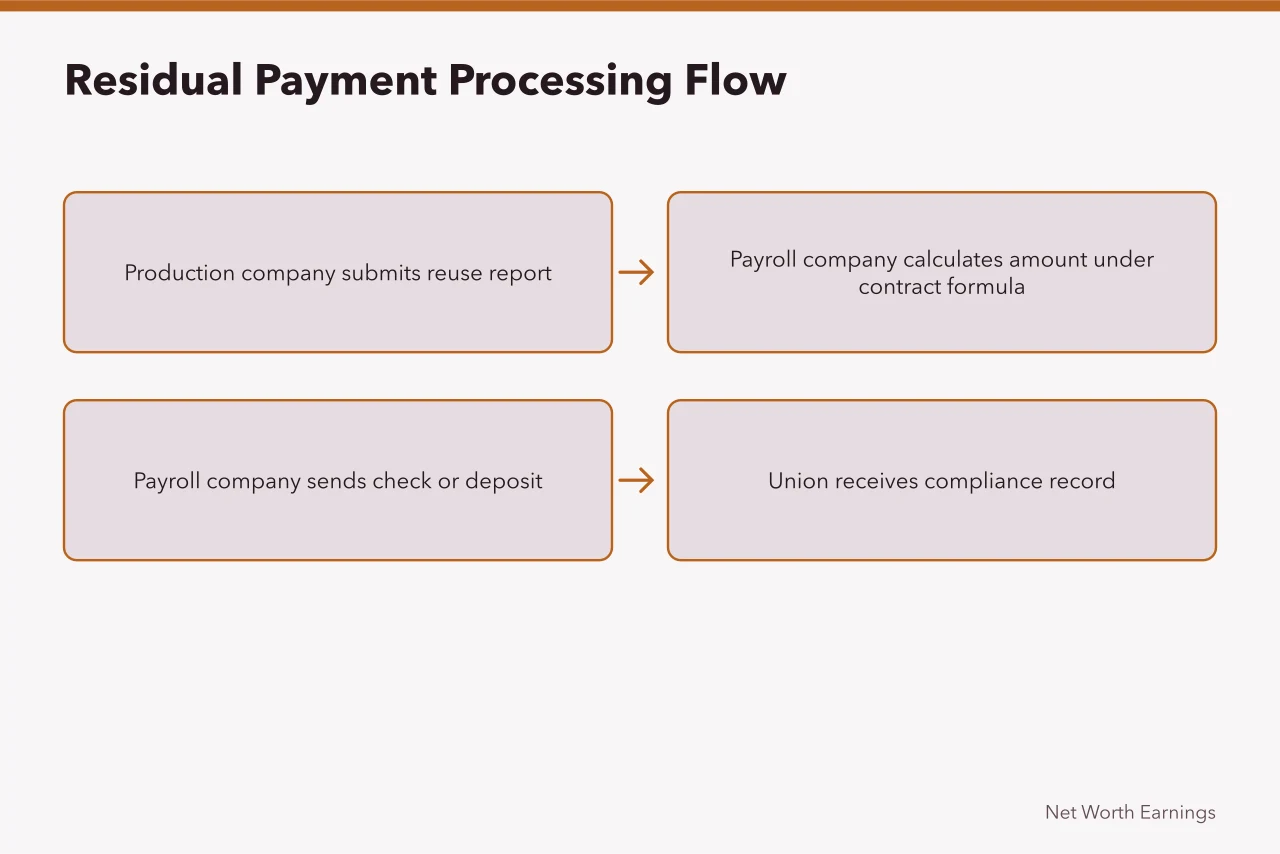
Actors working through a loan-out corporation may receive residuals paid to the corporation. The corporation pays the actor, changing the tax reporting form but not the underlying union obligation. The union tracks payment to the corporation as employer of record.
For minors in California, a Coogan account requires residuals be deposited into a blocked trust. The performer cannot access it until age 18.
Because residuals vary by market and media, the way an actor net worth estimate is built depends on public data, not private check stubs.
What happens when a producer skips a payment
A producer that misses the residual payment deadline, typically 30 days from the statement date, triggers a union process. SAG-AFTRA can file a grievance, and the contract requires the producer to pay interest and an administrative penalty. If the producer refuses, the guild can place the production company on a do-not-work list, which bars signatory work until the debt is cleared. That consequence is real: a signatory producer loses access to union performers, which stalls any new production.
An actor starts the process by filing an inquiry through the SAG-AFTRA member portal, and the union's residual claims department compares the claim against the signatory report. Members should file within the claim window, typically 90 days from the statement date. If the amount is owed, the department demands payment and tracks the file until the check clears.
Readers who want to see the broader pattern should review where actor earnings figures come from, because public earnings data often lags behind residual payment cycles.